

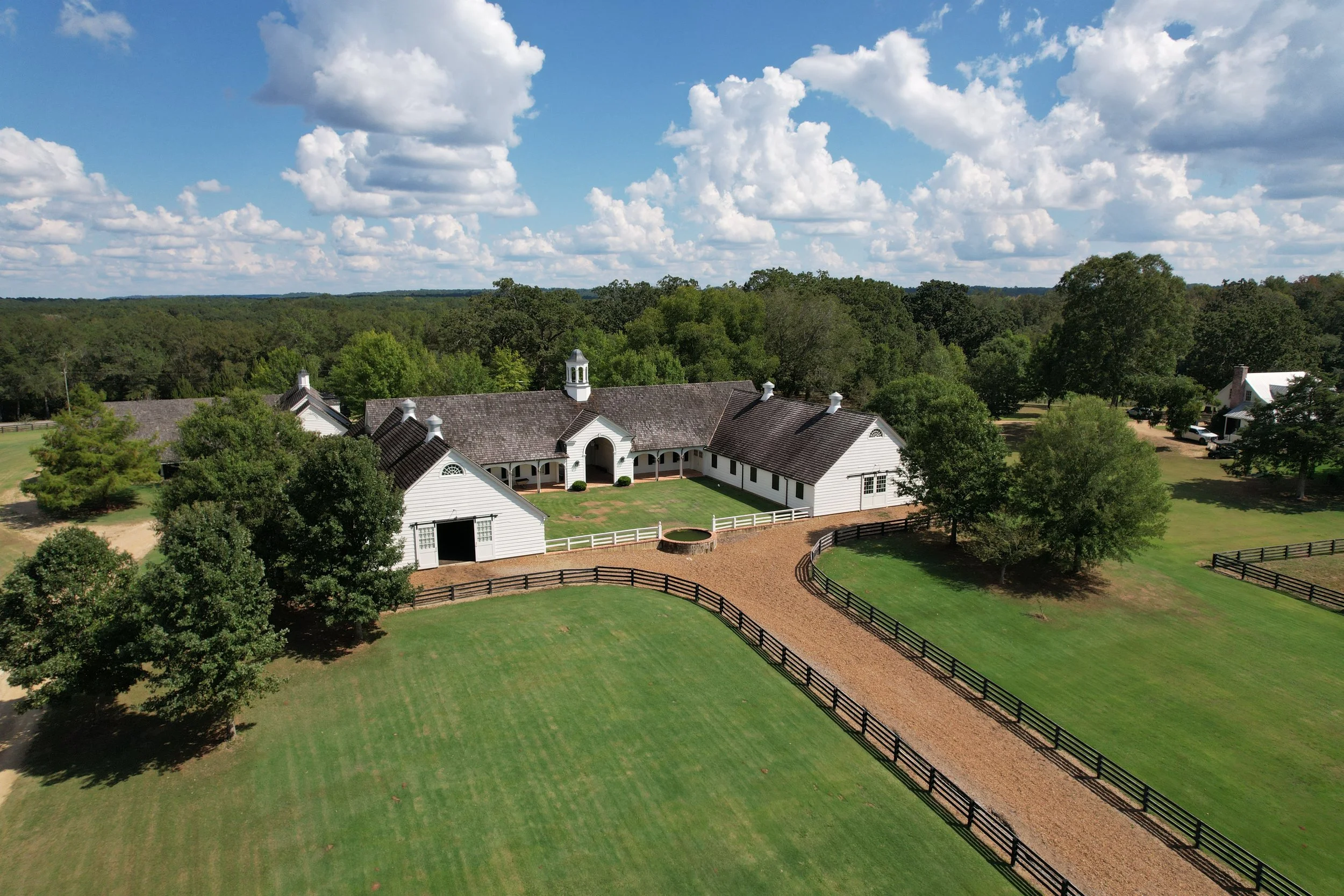
Sedgefields Plantation, Alabama
A 10,000-acre quail plantation in the Black Belt, and two hundred years of its history on a single sheet
Sedgefields sits on ten thousand acres of the Alabama Black Belt, in Bullock County, an hour east of Montgomery: a working quail plantation, owned by Raymond Harbert. Anthony was introduced through Michael Paderewski of Sportsman's Gallery in Charleston, met Mr Harbert in London, and over the following year made the map that now hangs in the hall of the main house, nine feet by five, beside the bar.
Two Seasons on the Ground
The survey took two visits of ten days, five months apart. The first came in September, with the trees still in leaf; the second in February, when the bare woods opened the long sightlines that summer cover had hidden. The February stay also took in three days' quail hunting with Mr Harbert and two days at the National Amateur Free-for-All Championship, the field trial held each year on the plantation.
Two Hundred Years of History
At Sedgefields the history is the heart of the work. The plantation's published history had taken two of Alabama's distinguished historians, Dr Leah Rawls Atkins and Katie Lamar Jackson, thirteen years to write, tracing the land from Muscogee Creek occupation through the antebellum cotton era and the railroads to the quail era and the present. Anthony was given the book and asked to distil it onto the map.
More came from the ground itself. Dean Spratlan, the Bullock County historian, keeps the county's working archive in his own garage, rarely seen by anyone outside the county; through him it reached the map, vanished cemeteries, lost churches, Muscogee Creek trails, the homesteads that stood here a century and more ago. Anthony walked parts of the plantation with members of the African American community descended from people enslaved here and still living within its borders: standing with one man at a mule barn he had built with his uncle in the 1950s, beside the foundations of the house where he grew up; going inside a nineteenth-century cabin with a woman in her eighties who remembered the last people to live in it. Their ancestors' cemeteries are among the sites on the map.
In the map room of the Auburn University library, Anthony worked through the earliest US land surveys of the Black Belt, drawn in the early 1800s when the land was first sectioned out of Creek territory, and dozens of aerial photographs from the 1940s onward, the land before mechanisation, before so many homesteads were lost. Cross-referenced with the archive, with the memories of the families still on the land, and with the ground itself, the aerial record placed nearly a hundred vanished homesteads exactly. Each is marked with the family name of the people who lived there.
The Working Plantation
The life of the modern plantation is recorded in the same detail. Seventy-five thousand individual trees were surveyed and placed. Every quail course and dove field is on the map, with the roads, ponds, working buildings and the main house. The illustrations, by the artist Jonathan Pointer, run throughout: the working dogs, the local wildlife, scenes from the sporting calendar, and a large illustration of the National Amateur Free-for-All Championship in progress, drawn from Anthony's days at the trials.
The Names on the Map
Down one border of the framed print runs an etymology panel: more than a hundred named sites across the plantation's eight tracts, each with a few sentences of provenance. The Muscogee Creek allottee who held the land until 1843. The church that burned during routine burning and was rebuilt in stone. The creek crossing made from salvaged railroad track. A grove of live oaks grown from the progeny of the Toomer's Oaks at Auburn. The names on the map are not labels. Each is a record of who was here, and what happened. The condensed history of the plantation, divided by era, is typeset within the print itself.
“Pelly’s classical masterpieces visually tell a tale, preserving the culture and foundation of our places.”
The Finished Map
The map measures nine feet by five, printed and framed in London on heavyweight archival paper, then crated and flown to Alabama by Momart, the fine-art shippers, in a flight case built for the delivery. It hangs beside the bar, the first thing family and guests see when they arrive and the last when they leave: somewhere to stand with an old fashioned in hand and pore over the ground. The historians' thirteen years and the year of the map ended up in the same room. One sits on the coffee table. The other is on the wall. When it was finished, Raymond Harbert asked Anthony to add a chapter to the published history, recording what the survey had found that the archive had not.